Publishing your first research paper is an important milestone in your academic journey. You may have spent months conducting research, analyzing data, reviewing previous studies, and preparing your findings. However, turning that research into a publishable manuscript can feel challenging when you are unfamiliar with the research paper publication process.
Which journal should you choose? How should you structure your manuscript? What happens after submission? How does peer review work? And what should you do if reviewers request revisions?
The process becomes much easier to understand when you break it into clear steps.
In this beginner-friendly guide, Future Matrix Publications explains how to publish your first research paper—from preparing your manuscript and selecting a suitable journal to peer review, revision, acceptance, and publication.
What Does Publishing a Research Paper Involve?
Academic publishing involves much more than simply uploading your manuscript to a journal website.
A typical research paper publishing process includes:
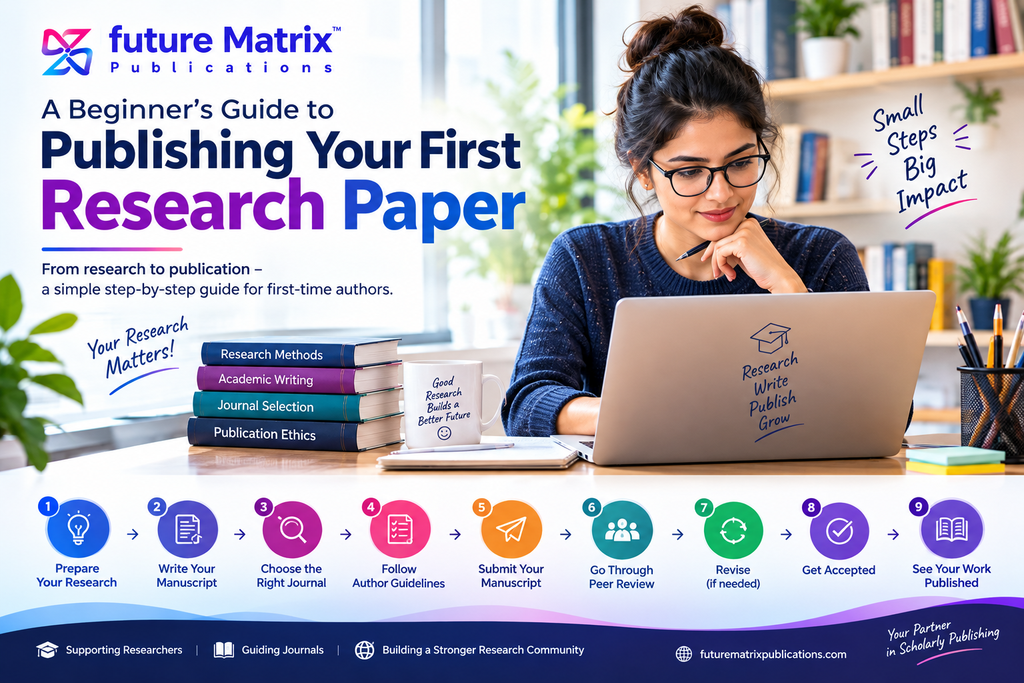
Research Completion → Manuscript Writing → Journal Selection → Formatting → Submission → Editorial Screening → Peer Review → Revision → Acceptance → Publication
Each stage has its own requirements, and careful preparation can help you avoid common mistakes and unnecessary delays.
Let’s understand the process step by step.
Step 1: Make Sure Your Research Is Ready for Publication
Before you start looking for journals, evaluate whether your research is ready to become a manuscript.
Your study should have a clearly defined research question or objective. You should also explain why the research matters and how it contributes to existing knowledge.
Ask yourself:
- What problem does my research address?
- What is the main research question?
- Why is this research important?
- Which methodology did I use?
- What are the key findings?
- How do my findings relate to previous research?
- What limitations does my study have?
- What new knowledge does my research contribute?
Clear answers to these questions will make the manuscript-writing process much easier.
Step 2: Structure Your Research Paper
Most original research papers follow a recognizable academic structure, although requirements vary by journal and discipline.
A common structure includes:
Title
Your title should clearly communicate the main subject of your research.
Keep it specific and informative rather than unnecessarily complicated.
Abstract
The abstract provides a concise overview of your research.
It usually summarizes:
- Background or research problem
- Objective
- Methodology
- Key results
- Main conclusion
Many readers will see your abstract before deciding whether to read the complete paper, so clarity matters.
Keywords
Choose keywords that accurately represent your research topic.
Relevant keywords can help databases and researchers understand the subject of your paper.
Introduction
The introduction establishes the research problem and explains why the study matters.
It should provide sufficient background, identify the research gap, and clearly state the objectives or research questions.
Literature Review
The literature review discusses relevant previous research and shows how your study connects with existing knowledge.
Avoid simply listing earlier studies. Instead, analyze and organize the literature around the problem your research addresses.
Methodology
Explain how you conducted your research.
Depending on the study, this section may describe:
- Research design
- Participants or data sources
- Sampling method
- Data collection
- Instruments
- Experimental procedures
- Statistical analysis
- Ethical considerations
Provide enough information for readers to understand how you reached your findings.
Results
Present the findings clearly and logically.
Use tables, figures, charts, or other visual elements when they improve understanding.
Avoid overstating what the data demonstrates.
Discussion
The discussion explains what your findings mean.
Compare your results with previous research, discuss their significance, explain unexpected findings where appropriate, and acknowledge relevant limitations.
Conclusion
Summarize the main findings and their significance.
A strong conclusion should answer the central research question without introducing unsupported claims.
References
List all sources according to the journal’s required citation style.
Always check references carefully for accuracy and consistency.
Step 3: Choose the Right Journal
Journal selection is one of the most important decisions in the publication process.
A well-written paper can still receive an early rejection if it does not match the journal’s scope.
Before submitting, evaluate:
- Aims and scope
- Subject area
- Target readership
- Recently published articles
- Accepted article types
- Peer-review model
- Publication frequency
- Open-access options
- Article processing charges, if applicable
- Indexing information
- Author guidelines
Reading several recently published articles can help you understand whether your research fits the journal.
Be Careful with Journal Claims
Do not choose a journal solely because it promises extremely fast publication or claims impressive metrics.
Verify important information through reliable sources and the journal’s official website.
Researchers should also check indexing claims directly through the relevant indexing service whenever possible.
Step 4: Read the Author Guidelines Carefully
Every journal provides author guidelines or instructions for authors.
These guidelines explain how authors should prepare and submit manuscripts.
They may specify:
- Word limits
- Manuscript structure
- Reference style
- Abstract length
- Number and format of keywords
- Figure requirements
- Table formatting
- Supplementary files
- Cover-letter requirements
- Ethical declarations
- Data-availability statements
- Conflict-of-interest statements
Ignoring these instructions can delay the submission process.
Create a simple checklist and verify each requirement before submitting your manuscript.
Step 5: Improve the Quality of Your Manuscript
Before submission, review the complete paper carefully.
Check for:
Clarity: Can readers understand your arguments easily?
Consistency: Do terminology, abbreviations, headings, tables, and references remain consistent?
Academic Language: Have you removed unnecessary repetition and unclear sentences?
Evidence: Do your conclusions reflect your actual results?
References: Have you cited relevant sources accurately?
Figures and Tables: Are they clear, numbered correctly, and referenced within the manuscript?
Ask a colleague, supervisor, or subject expert to review the manuscript when possible.
A fresh reader may identify problems that you overlooked after working on the paper for a long time.
Step 6: Check Research and Publication Ethics
Ethical publishing practices are essential.
Before submission, authors should consider issues such as:
- Originality
- Proper citation
- Authorship
- Conflicts of interest
- Research ethics approval where applicable
- Informed consent where applicable
- Data integrity
- Duplicate or redundant publication
Never copy text, data, figures, or ideas from another source without appropriate attribution and permission where required.
All listed authors should meet the journal’s authorship requirements and understand the submitted work.
Researchers should also avoid submitting the same manuscript to multiple journals simultaneously unless the journals’ policies explicitly permit a specific arrangement.
Step 7: Prepare a Strong Cover Letter
Some journals require a cover letter during manuscript submission.
A good cover letter usually introduces the manuscript briefly and explains why the research fits the journal.
It may include:
- Manuscript title
- Article type
- Main research contribution
- Relevance to the journal
- Confirmation of originality
- Required ethical or conflict-of-interest declarations
Keep the letter professional and concise.
Avoid exaggerated claims such as calling your study “groundbreaking” unless you can objectively support that statement.
Step 8: Submit Your Manuscript
Once everything is ready, submit your manuscript through the journal’s official submission system.
Many journals use platforms such as Open Journal Systems (OJS) or other editorial management systems.
During submission, you may need to enter:
- Title
- Abstract
- Keywords
- Author information
- Affiliations
- ORCID information
- Funding details
- Conflicts of interest
- Suggested reviewers, if requested
- Manuscript files
- Figures and supplementary materials
Check every detail before completing the submission.
After submission, save the manuscript ID or submission reference number.
Step 9: Initial Editorial Screening
The journal normally reviews the manuscript before sending it for external peer review.
Editors may assess whether:
- The manuscript fits the journal’s scope
- The article meets basic quality requirements
- The submission follows journal guidelines
- The subject offers sufficient relevance for the journal’s readership
- Required documentation is present
The journal may return the manuscript for technical corrections or decide not to send it for external review.
An editorial rejection at this stage does not necessarily mean that the research has no value. Sometimes the manuscript simply does not fit that particular journal.
Step 10: Understand the Peer Review Process
If the manuscript passes the initial screening, the journal may send it to independent experts for peer review.
Reviewers can examine:
- Research originality
- Methodology
- Results
- Interpretation
- Academic relevance
- Writing clarity
- References
- Ethical considerations
After evaluating the manuscript, reviewers provide comments and recommendations to the editor.
The editor then decides what should happen next according to the journal’s editorial procedures.
Possible decisions may include:
Accept
Minor Revision
Major Revision
Reject
For first-time researchers, receiving revision requests is completely normal.
A revision request gives you an opportunity to improve your manuscript.
Step 11: Respond to Reviewer Comments Professionally
If reviewers request changes, read every comment carefully.
Prepare a response-to-reviewers document and address comments individually.
For example:
Reviewer Comment: Please explain the participant selection criteria more clearly.
Author Response: Thank you for this helpful comment. We have expanded the participant selection criteria in the Methods section and clarified the inclusion and exclusion requirements.
When you make a change, clearly indicate where you made it.
If you disagree with a reviewer, explain your reasoning professionally and support your position with appropriate evidence.
Avoid emotional or defensive responses.
Step 12: Submit Your Revised Manuscript
After completing the revisions, review the manuscript again before resubmission.
Make sure you have:
- Addressed every reviewer comment
- Responded to editorial comments
- Updated the manuscript consistently
- Corrected references where necessary
- Uploaded the correct files
- Included your response-to-reviewers document
The editor may evaluate the revised manuscript directly or send it back to reviewers.
Some papers require multiple revision rounds.
Step 13: Acceptance and Production
If the journal accepts your manuscript, congratulations—you have reached a major milestone.
However, the process may not end immediately.
The paper usually enters a production workflow that can include:
Copy editing → Typesetting → Proofreading → Author Approval → Online Publication
Review your proofs carefully.
Check author names, affiliations, tables, figures, equations, references, and other important details.
Follow the journal’s instructions when requesting corrections.
Step 14: Promote Your Published Research
Publication should not necessarily mark the end of your involvement with the paper.
Once the journal publishes your article, you can help relevant researchers discover it.
Depending on the journal’s sharing and copyright policies, you may:
- Share the publication through professional networks
- Add it to your ORCID record
- Update your institutional profile
- Discuss the findings at conferences
- Share an approved version through permitted repositories
- Communicate your findings through appropriate academic or professional channels
Always follow the journal’s copyright and sharing policies.
Common Mistakes First-Time Authors Should Avoid
New researchers often make avoidable mistakes during their first research paper publication.
Watch out for:
- Choosing a journal without checking its scope
- Ignoring author guidelines
- Submitting an unfinished manuscript
- Using inconsistent references
- Overstating research conclusions
- Responding poorly to reviewers
- Missing important ethical declarations
- Submitting to multiple journals simultaneously
- Trusting unverified indexing claims
- Expecting guaranteed acceptance
No legitimate publication-support provider can control an independent journal’s editorial decision.
First Research Paper Publication Checklist
Before you click Submit, check:
☐ Does my paper clearly explain its research question?
☐ Have I selected an appropriate journal?
☐ Does my manuscript follow the journal’s author guidelines?
☐ Have I checked grammar and academic language?
☐ Are all citations and references accurate?
☐ Have I prepared all required declarations?
☐ Are figures and tables correctly formatted?
☐ Have all authors approved the submission?
☐ Have I checked the journal’s publication and peer-review policies?
☐ Am I submitting through the journal’s official system?
If you can confidently check these items, you are much better prepared for your first submission.
How Future Matrix Publications Can Support Researchers
Publishing your first research paper can feel complicated because authors need to manage manuscript preparation, journal requirements, submission procedures, and reviewer feedback at different stages.
Future Matrix Publications provides academic publishing support for researchers who need assistance navigating these processes.
Depending on the researcher’s requirements, support may include:
- Manuscript assessment
- Academic editing coordination
- Manuscript formatting
- Journal selection assistance
- Submission preparation
- Publication-process guidance
- Response-to-reviewer assistance
- Research publication support
Our goal is to help researchers prepare and manage their manuscripts professionally while respecting the independence of scholarly publishing.
Journal editors and independent peer reviewers remain responsible for manuscript evaluation, peer review, acceptance, and rejection decisions.
Conclusion
Publishing your first research paper becomes easier when you understand the process.
Start with strong research, prepare a well-structured manuscript, choose a suitable journal, follow its author guidelines, and approach peer review professionally.
Remember this simple publication journey:
Research → Write → Select → Prepare → Submit → Review → Revise → Publish
Your first paper may require revisions, corrections, and patience. Each stage also gives you valuable experience that can improve your future research and academic writing.
Future Matrix Publications supports researchers throughout their academic publishing journey by providing professional assistance with manuscript preparation and the publication process.