In today’s academic publishing environment, visibility, transparency, and credibility are essential for the long-term growth of a scholarly journal. Researchers want to publish their work in journals that are easy to discover, follow recognized publishing standards, and provide transparent information about their editorial and peer-review practices.
For open-access journals, one of the most recognized platforms supporting these goals is the Directory of Open Access Journals (DOAJ).
But what exactly is DOAJ indexing, and why should journal publishers consider applying for it?
In this article, Future Matrix Publications explains the importance of DOAJ indexing, its benefits, key requirements, and how proper journal preparation can improve the chances of a successful DOAJ application.
What Is DOAJ?
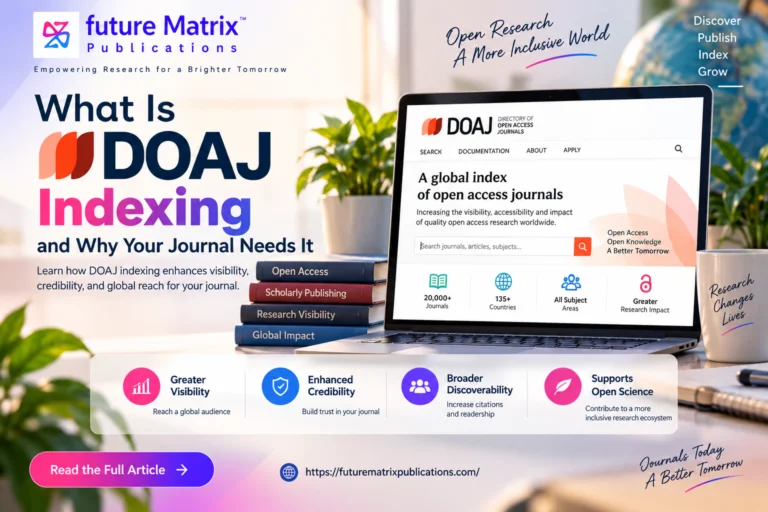
The Directory of Open Access Journals (DOAJ) is an independent online directory that indexes high-quality, peer-reviewed, open-access scholarly journals from around the world.
DOAJ aims to increase the visibility, accessibility, reputation, usage, and impact of quality open-access scholarly journals.
Being included in DOAJ indicates that a journal has demonstrated alignment with important principles related to open access, editorial transparency, peer review, publishing ethics, licensing, copyright, and journal governance.
However, DOAJ inclusion should not be viewed simply as adding a journal to another database. Journals are evaluated against DOAJ’s criteria before they are accepted.
What Does DOAJ Indexing Mean for a Journal?
When a journal is accepted into DOAJ, its journal information becomes discoverable through the DOAJ platform. Publishers can also provide article metadata according to DOAJ’s supported processes.
For researchers and institutions, DOAJ inclusion can serve as an important indicator that an open-access journal publicly provides key information about how it operates.
This can help build confidence among authors, reviewers, editors, librarians, and academic institutions.
Why Does Your Journal Need DOAJ Indexing?
1. Greater Global Visibility
One of the biggest challenges faced by new and developing journals is discoverability.
A journal may publish valuable research, but its potential impact is limited if researchers cannot easily find its content.
DOAJ helps improve the international discoverability of open-access journals and their published research.
Greater visibility may help journals reach researchers, authors, institutions, and readers from different countries and academic disciplines.
2. Improved Journal Credibility
Academic authors carefully evaluate journals before submitting their manuscripts.
They may review the journal’s editorial board, peer-review process, publication ethics, indexing status, copyright policy, licensing terms, and publishing history.
DOAJ inclusion can strengthen a journal’s credibility because the journal has undergone an evaluation against DOAJ’s inclusion criteria.
It does not guarantee the quality of every individual article, but it can demonstrate that the journal has established transparent publishing policies and practices expected of journals listed in the directory.
3. Increased Accessibility of Research
Open-access publishing is designed to make scholarly research available without unnecessary access barriers.
DOAJ supports this objective by helping readers discover open-access journals and research from around the world.
For publishers, this means research can potentially reach a wider academic audience beyond traditional subscription-based environments.
4. Stronger Publishing Transparency
DOAJ places significant emphasis on transparency.
A journal should clearly communicate important information such as:
- Aims and scope
- Editorial board information
- Peer-review process
- Open-access policy
- Copyright and licensing terms
- Author guidelines
- Publication ethics
- Article processing charges (APCs), where applicable
- Editorial contact information
- Archiving and preservation arrangements
Clear policies are valuable not only for a DOAJ application but also for building a professionally managed scholarly journal.
5. Better Author Confidence
Researchers increasingly check a journal’s reputation and publishing practices before submitting their manuscripts.
Transparent policies and recognized indexing can make authors more confident when considering a journal.
DOAJ inclusion may therefore support a journal’s efforts to attract legitimate scholarly submissions and develop stronger relationships with authors and researchers.
Key Requirements for DOAJ Indexing
DOAJ applications involve a detailed assessment, and simply operating an open-access journal does not automatically make a journal eligible.
Publishers should carefully review the current DOAJ criteria before applying.
Important areas generally include:
Open Access: The journal must provide appropriate open access to its scholarly content in accordance with DOAJ requirements.
Peer Review: The journal should clearly describe its editorial and peer-review process.
Editorial Board: Editorial board members should be clearly identified, and the board should be appropriate for the journal’s scope and operation.
Publication Ethics: Policies covering academic integrity and publishing ethics should be clearly available.
Copyright and Licensing: Authors and readers should be able to understand the journal’s copyright and licensing arrangements.
APC Transparency: If authors are required to pay publication or processing charges, those charges should be clearly stated. If there are no charges, this should also be communicated appropriately.
Journal Website: The website should provide accurate, accessible, and consistent information about the journal and its publishing processes.
Incomplete, inconsistent, or unclear information across these areas can create problems during an application assessment.
Common Problems Before a DOAJ Application
A journal may appear ready for indexing while still containing issues that should be corrected before submission.
For example, publishers may have inconsistent information between the Open Access Policy and Copyright Policy, incomplete editorial board profiles, unclear peer-review descriptions, missing licensing information, outdated author guidelines, or contradictory APC information.
Website navigation and policy accessibility can also affect how clearly the journal’s publishing practices are presented.
For this reason, conducting a comprehensive pre-application journal audit can be extremely valuable.
How Future Matrix Publications Can Help
Preparing a journal for DOAJ requires more than completing an application form.
At Future Matrix Publications, we provide professional journal publishing and indexing assistance designed to help publishers identify gaps and prepare their journals according to relevant indexing requirements.
Our DOAJ support process may include:
- Journal website and policy review
- DOAJ readiness assessment
- Editorial and peer-review policy review
- Open-access policy assessment
- Copyright and licensing review
- Publication ethics assessment
- APC and fee transparency review
- Author guideline review
- Editorial board information review
- Website content recommendations
- Application preparation support
- Post-submission guidance and communication support
Our approach focuses on identifying potential compliance gaps before submission and helping publishers strengthen the overall transparency and professionalism of their journals.
DOAJ Indexing Is More Than a Badge
DOAJ inclusion should not be treated merely as a logo or indexing label displayed on a journal website.
The real value lies in building a journal around transparent editorial processes, responsible open-access practices, clear publishing policies, and internationally recognized scholarly publishing principles.
For emerging journals in particular, preparing for DOAJ can also provide an opportunity to review and improve the journal’s overall publishing infrastructure.
Is Your Journal Ready for DOAJ?
Before submitting an application, journal publishers should ask:
Does our website clearly explain our peer-review process?
Are our copyright and licensing policies consistent?
Are publication fees clearly disclosed?
Is our editorial board properly presented?
Are our publication ethics policies comprehensive?
Are our author guidelines clear and up to date?
Does our journal currently satisfy DOAJ’s latest eligibility and transparency requirements?
If the answer to any of these questions is uncertain, a professional readiness assessment can help identify areas requiring improvement before an application is submitted.
Conclusion
DOAJ indexing can be an important milestone in the development of an open-access scholarly journal. It can contribute to greater discoverability, stronger publishing transparency, increased author confidence, and wider access to published research.
Successful inclusion, however, requires journals to demonstrate that their editorial policies, website information, open-access practices, peer-review procedures, and publishing standards meet DOAJ’s requirements.
Future Matrix Publications supports journal publishers throughout this process—from initial journal assessment and policy review to application preparation and post-submission guidance.
If you are planning to apply for DOAJ indexing and want to understand whether your journal is ready, contact Future Matrix Publications for a comprehensive DOAJ readiness assessment.