
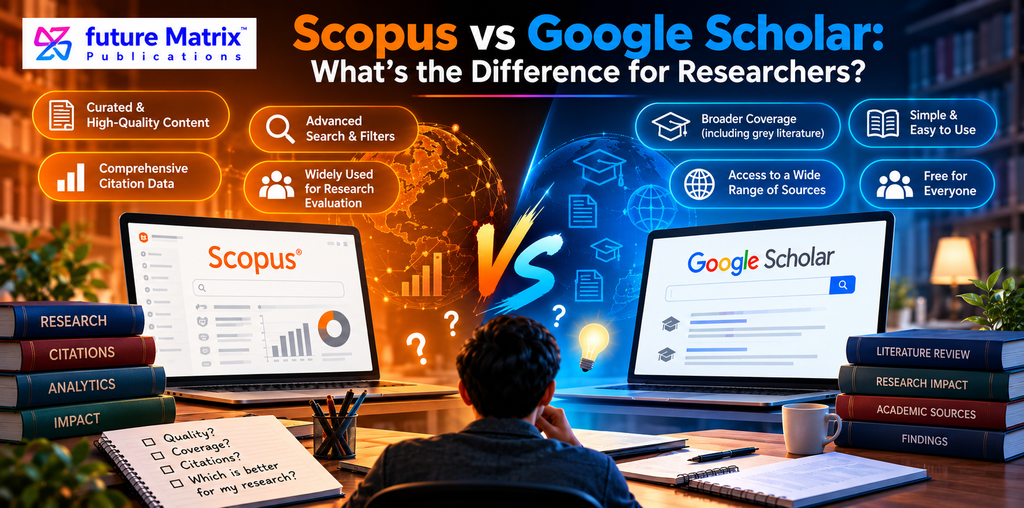
Researchers search for academic literature, track citations, or evaluate their work’s visibility.
Scopus vs Google Scholar explained, it compares coverage, citation tracking, indexing, search features, metrics, and which platform researchers should use.
Both platforms help researchers discover scholarly literature and citation information, but they are designed differently. Their coverage, selection methods, search capabilities, citation counts, and access models can vary considerably.
Understanding these differences can help researchers choose the appropriate platform for literature searches, citation analysis, research evaluation, and academic discovery.
What Is Scopus?
Scopus is an abstract and citation database developed by Elsevier. This article includes the focus: “Scopus vs Google Scholar explained. Compare coverage, citation tracking, indexing, search features, research metrics, and which platform researchers should use.” It indexes scholarly literature from thousands of academic sources, including peer-reviewed journals, conference proceedings, books, and book series.
One of the distinguishing characteristics of Scopus is its curated approach to source coverage. Publications considered for inclusion are evaluated according to defined selection criteria.
Researchers commonly use Scopus to:
- Search scholarly literature
- Identify relevant journals and publications
- Track citations
- Review author profiles
- Analyze research trends
- Explore institutional research output
- Conduct bibliometric and citation analysis
Scopus also provides analytical tools and metrics that can support research assessment and bibliometric studies.
What Is Google Scholar?
Google Scholar is a freely accessible academic search engine provided by Google.
Rather than functioning primarily as a curated citation database, Google Scholar automatically discovers scholarly material available across the web.
Its coverage can include:
- Journal articles
- Conference papers
- Books and book chapters
- Theses and dissertations
- Institutional repository documents
- Preprints
- Technical reports
- Other scholarly and academic materials
This broad discovery approach makes Google Scholar particularly useful when researchers want to search across many different types of academic content from a single interface.
Scopus vs Google Scholar: Key Differences
Although both services can help researchers find scholarly information, there are several important differences.
1. Coverage
Scopus focuses on content from sources that meet its coverage and selection requirements.
Google Scholar searches much more broadly across scholarly material available online, including institutional repositories, theses, preprints, and other materials that may not be indexed in Scopus.
As a result, researchers may find documents through Google Scholar that are unavailable in Scopus.
However, broader coverage does not automatically mean that every retrieved source has undergone the same type of selection or quality-control process.
2. Source Selection
One of the most significant differences between the platforms is how content becomes discoverable.
Scopus applies formal content selection policies and evaluates sources before they are accepted for coverage.
Google Scholar largely relies on automated web crawling and indexing.
Therefore, researchers conducting structured bibliometric studies may prefer databases with clearly defined coverage and selection methodologies, while Google Scholar can be valuable for discovering a wider range of scholarly materials.
3. Citation Counts
Researchers sometimes notice that the same article has different citation numbers in Scopus and Google Scholar.
This is normal.
Because the platforms index different sets of documents, their citation counts can differ. Google Scholar’s broader coverage may identify citations from materials that are not covered by Scopus.
Therefore, citation numbers from different databases should not automatically be treated as directly interchangeable.
When reporting citation metrics, researchers should ideally mention the database from which the metric was obtained.
For example:
“The article received 35 citations in Scopus.”
is more informative than simply stating:
“The article received 35 citations.”
4. Search and Filtering
Depending on the search being conducted, researchers can use fields, filters, Boolean operators, subject categories, publication years, document types, affiliations, authors, and other parameters to refine results.
Google Scholar offers a comparatively simple search experience.
Its interface is convenient for quickly locating papers, authors, citations, and related literature, but it generally provides fewer options for highly structured database searching.
5. Research Analytics
Scopus provides several tools designed for citation and research analysis.
Researchers can examine citation information, author records, publication histories, affiliations, and other bibliometric data.
Google Scholar also provides useful citation information and author profiles, including metrics such as citation counts and h-index information.
However, its primary strength is straightforward scholarly discovery rather than providing the same type of curated bibliometric environment.
6. Accessibility
Another major difference is access.
Google Scholar is free to search.
Scopus generally requires institutional or subscription-based access, although some Scopus-related information and tools may be publicly accessible.
For researchers without access through a university, institution, or organization, Google Scholar can therefore be especially useful for academic discovery.
It is also important to remember that finding an article in either platform does not necessarily mean that the article’s full text is freely available. Access to the complete publication depends on the publisher and the article’s access status.
Quick Comparison
| Feature | Scopus | Google Scholar |
|---|---|---|
| Platform Type | Abstract & citation database | Academic search engine |
| Source Selection | Curated selection process | Primarily automated discovery |
| Coverage | Selected scholarly sources | Broad scholarly web coverage |
| Citation Tracking | Yes | Yes |
| Advanced Search & Filtering | Extensive | More limited |
| Bibliometric Analysis | Strong | Basic to moderate |
| Author Profiles | Yes | Yes |
| Free to Search | Generally subscription-based | Yes |
| Grey Literature Discovery | More limited | Broader |
| Useful for Literature Discovery | Yes | Yes |
Why Citation Counts Differ Between Scopus and Google Scholar
Suppose a research paper shows:
Scopus: 42 citations
and
Google Scholar: 61 citations
This does not necessarily mean that one platform has made an error.
The difference can result from their respective coverage policies.
Google Scholar may discover citations from theses, repositories, preprints, conference documents, or other scholarly materials that are not covered by Scopus.
Scopus citation counts are based on documents available within its indexed content.
This is why researchers should identify the source database whenever they report citation statistics.
Which Platform Should Researchers Use?
However, rather than treating Scopus and Google Scholar as direct substitutes, Scopus vs Google Scholar explained, researchers can use them for different purposes.
Scopus can be particularly useful when you need:
- Structured literature searching
- Curated source coverage
- Citation analysis
- Bibliometric research
- Author and affiliation analysis
- Research-performance data
Google Scholar can be particularly useful when you need:
- Quick academic searches
- Broad literature discovery
- Theses, repositories, and other scholarly materials
- Freely accessible searching
- Additional versions of research papers
- A simple way to explore citations and related studies
For a comprehensive literature search, researchers may benefit from consulting multiple scholarly databases and discovery tools rather than relying entirely on a single platform.
Is a Journal Being Visible on Google Scholar the Same as Being Indexed in Scopus?
No.
A journal or article appearing in Google Scholar does not mean that the journal is indexed in Scopus.
Google Scholar discovers scholarly content from across the web, whereas Scopus has its own source evaluation and coverage process.
Researchers, authors, and journal publishers should therefore verify indexing claims through the relevant database’s official sources rather than assuming that visibility in one scholarly search platform confirms inclusion in another.
Final Thoughts
Scopus and Google Scholar both play valuable roles in academic research, but they serve researchers in different ways.
Scopus emphasizes curated scholarly coverage, structured searching, citation information, and research analytics.
Google Scholar emphasizes broad, accessible discovery of scholarly material across the web.
For researchers, the question therefore does not always need to be “Scopus or Google Scholar?”
A more useful question is:
“Which platform is appropriate for the research task I am performing?”
Using the strengths of both platforms—and other subject-specific databases where appropriate—can provide researchers with a more complete view of the academic literature.
About Future Matrix Publications
Future Matrix Publications supports academic journals and publishers with professional journal publishing, indexing preparation, and publication development services.
Our services include support for journal development, indexing readiness, publishing workflows, editorial standards, and academic publishing best practices.
For more information about our journal publishing and indexing services, contact Future Matrix Publications.